Introducing Reindustri - when AI Designs the Machine

Mapping how AI is being used to design the next set of machines
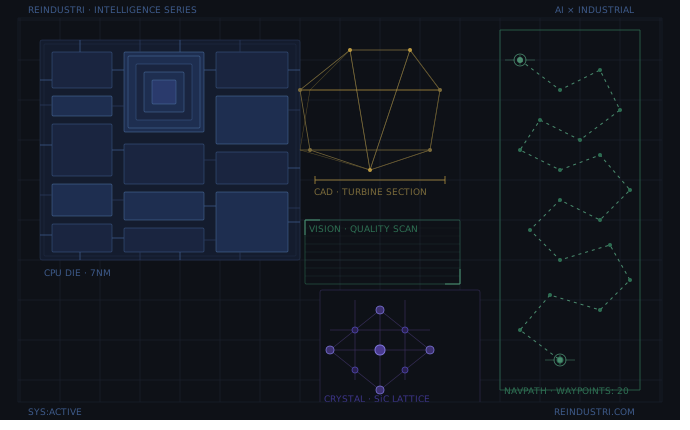
AI is no longer just augmenting industrial engineering, in the most advanced labs and startups today, it is actually already doing the engineering work such as generating chip layouts, simulating material failure, navigating autonomous vehicles in real time and compressing decades of CAD iteration into hours. At Reindustri we map the AI solutions to physical problems and what it means for the people building and funding the next generation of industrial companies.
01 — The new design layer
The most important shift in industrial engineering over the last three years is not automation on the production line. It is the collapse of the boundary between simulation and design. For most of engineering history, these were sequential: design, simulate, redesign. AI collapses the loop and the model generates geometry that is already pre-optimised against constraints the human never explicitly specified.
In generative CAD, tools like Autodesk Fusion's AI generative capabilities and Ansys' physics-simulation stack allow a designer to define loads, materials, and manufacturing constraints, then let a model explore millions of possible geometries overnight. The output looks nothing like what a human would draw — organic, latticed, sometimes unsettling — but it routinely outperforms conventional designs on weight, strength, and thermal performance simultaneously. For a manufacturing founder, this compresses hardware iteration from months to days.
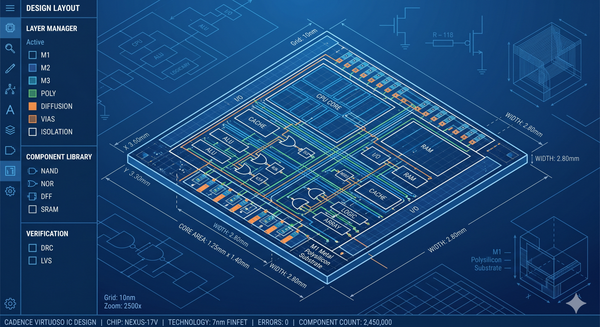
In semiconductor design, the transformation is more dramatic. Google's AlphaChip demonstrated that a reinforcement-learning agent could produce chip layouts in hours that took human experts weeks — and outperform them on key metrics. Synopsys and Cadence are now racing to embed generative AI across their entire EDA toolchains: RTL generation, place-and-route, timing closure, power analysis. The implication for anyone thinking about the semiconductor supply chain is significant: the bottleneck is shifting from design talent to compute and data access.
02 — Materials intelligence
One of the most underappreciated AI applications in industrial contexts is materials optimisation. Traditionally, discovering a new alloy, polymer, or composite required years of physical experimentation. Graph neural networks, trained on crystallographic databases like the Materials Project, can now predict properties such as conductivity, tensile strength, thermal expansion, corrosion resistance, from atomic-level structure alone, before a single gram of material is synthesised.
DeepMind's GNoME model proposed 2.2 million novel stable crystal structures in a single study, roughly 45 years of prior materials science discovery, compressed into one model run.
For manufacturing founders, this means a startup building next-generation battery electrodes, lightweight drone frames, or high-temperature turbine coatings now has access to a discovery pipeline that previously required a national laboratory. The constraint is no longer finding candidates — it is synthesising and validating them at speed, which is where automated lab systems (robotic synthesis combined with AI-driven experimental design) are now closing the final gap.
03 — Autonomous navigation and drone intelligence
Commercial drone navigation has followed a familiar AI maturation curve: rules-based flight controllers gave way to sensor fusion with Kalman filters, which are now being displaced by learned policies trained in simulation and deployed on edge hardware. The current frontier is vision-language model integration — drones that interpret natural-language mission objectives and adapt in real time to environments they have never seen.
What makes this technically interesting from an industrial standpoint is the edge compute constraint. A commercial drone cannot run a 70-billion-parameter model on a remote server while executing a high-speed inspection pass. The models that matter for drone navigation are quantised, pruned, and purpose-built for inference on hardware running at 5–15 watts. NVIDIA's Jetson Orin module runs SLAM, object detection, and path planning pipelines that would have required a server rack five years ago. The intelligence is not in the cloud — it is on the vehicle.
04 — The Raspberry Pi in the industrial AI stack
The Raspberry Pi 5, paired with the Hailo-8 AI accelerator module (26 TOPS via PCIe), can run real-time object detection, quality vision inspection, and predictive sensor analysis at a bill-of-materials cost under $200. This matters enormously for micro-factory economics. A traditional machine vision system from Cognex or Keyence costs US$8,000–$40,000 per station. A Pi 5 with Hailo-8 and a custom-trained YOLO model running at 30fps costs a fraction of that.
The limitation is model complexity and throughput — but for a focused industrial task (detecting a specific defect class, reading a torque sensor, monitoring a thermal profile), it is often sufficient. The broader point: AI-capable edge hardware has democratised what previously required specialist industrial compute.
05 — Which AI models serve which industrial purposes
Not all AI architectures suit all industrial problems and the choice of model type is itself an engineering decision. Non-technical investors get wrong by defaulting to "use an LLM", this being a generic solution for a complex AI case.
Large language models (GPT-4o, Claude): best for parsing legacy documentation and maintenance manuals, generating structured outputs from unstructured engineering reports, and scripting PLC/SCADA automation. Cloud-deployed; not suitable for real-time control.
Vision transformers (ViT, DINOv2): visual quality inspection, defect classification, dimensional measurement. Outperform CNNs on small-dataset industrial vision tasks due to better transfer learning, these can run on a Pi 5 + Hailo-8 at production framerates.
Graph neural networks (GNoME, SchNet): materials property prediction from molecular structure, PCB and chip layout optimisation and increasingly embedded in commercial EDA and materials informatics platforms.
Reinforcement learning (PPO, SAC): robot arm motion planning, chip floorplanning, drone path optimisation, CNC toolpath generation. Trained in simulation (Isaac Sim, MuJoCo), deployed on Jetson Orin or equivalent edge hardware.
Physics-informed neural networks (PINNs, FNO): CFD surrogate models running up to 10,000x faster than traditional finite element analysis these provide structural stress prediction, thermal simulation, turbine blade aerodynamics. Potentially replacing Ansys and COMSOL workflows in many engineering pipelines.
Small language models (Phi-3 Mini, Mistral 7B): on-device natural language interfaces for machinery, anomaly detection narration, local chatbot over equipment manuals without cloud dependency. Critical for air-gapped industrial environments. A 4-bit quantised Mistral 7B runs on 6GB of RAM, deployable on a Jetson Orin or industrial PC.
06 — What this means for founders and investors
The industrial AI stack is no longer one model doing everything. It is a multi-partsystem: an LLM handling documentation and interfaces at the top, vision transformers doing perception in the middle, reinforcement learning agents executing physical decisions at the bottom, and physics-informed networks running simulation in parallel. A founder who understands how to assemble and finance that stack and which components can be commoditised versus which represent defensible IP has a significant structural advantage.
This is the analytical territory Reindustri covers, which is the specific technical and financial decisions that arise when the two meet in the creation of real products or the setup of a real production process.